Viper Valorant Guide: Abilities, Strategies & Pro Tips (2024)
In the ever-evolving world of Valorant esports, understanding the nuances of agent selection and strategy is crucial for success. Viper, the toxic controller, has long been a pivotal figure in shaping team compositions and dictating map control. As someone deeply immersed in the Valorant scene, observing professional matches and analyzing meta trends, it’s clear that Viper’s influence remains significant, though her role has adapted over time.
The current Valorant meta sees Viper as a strategic pick, with her ability to section off areas and delay pushes proving invaluable. Even with agent additions and balance adjustments, teams consistently gravitate towards Viper for her unique utility. This article will explore Viper’s current standing in professional play, examining her pick rates across different regions and dissecting the compositions that maximize her potential.
Notably, during the VCT 2026 Kickoff, Viper maintained a commanding 54.69% pick rate in the Americas, underscoring her continued importance in the competitive landscape [thespike.gg].
Viper: The Serpent of Strategy
Viper stands out in Valorant as a controller and sentinel hybrid, offering a unique blend of abilities that set her apart from other agents. Unlike typical controllers who primarily focus on vision blocking, Viper excels at both controlling space and delaying enemy pushes, making her a strategic asset on any team. She is like a queen in chess, valuable for both attack and defense.
Viper’s playstyle revolves around calculated aggression and area denial. Her toxic abilities not only obstruct vision but also inflict damage over time, forcing enemies to think twice before entering her domain. This makes her particularly effective at holding down sites and controlling key choke points.
Strengths: Exceptional map control, post-plant prowess, ability to shut down areas.
Weaknesses: Limited mobility, fuel-dependent abilities, and predictable wall placement.
Mastering Viper’s Arsenal: Ability Deep Dive
Toxic Screen [E]
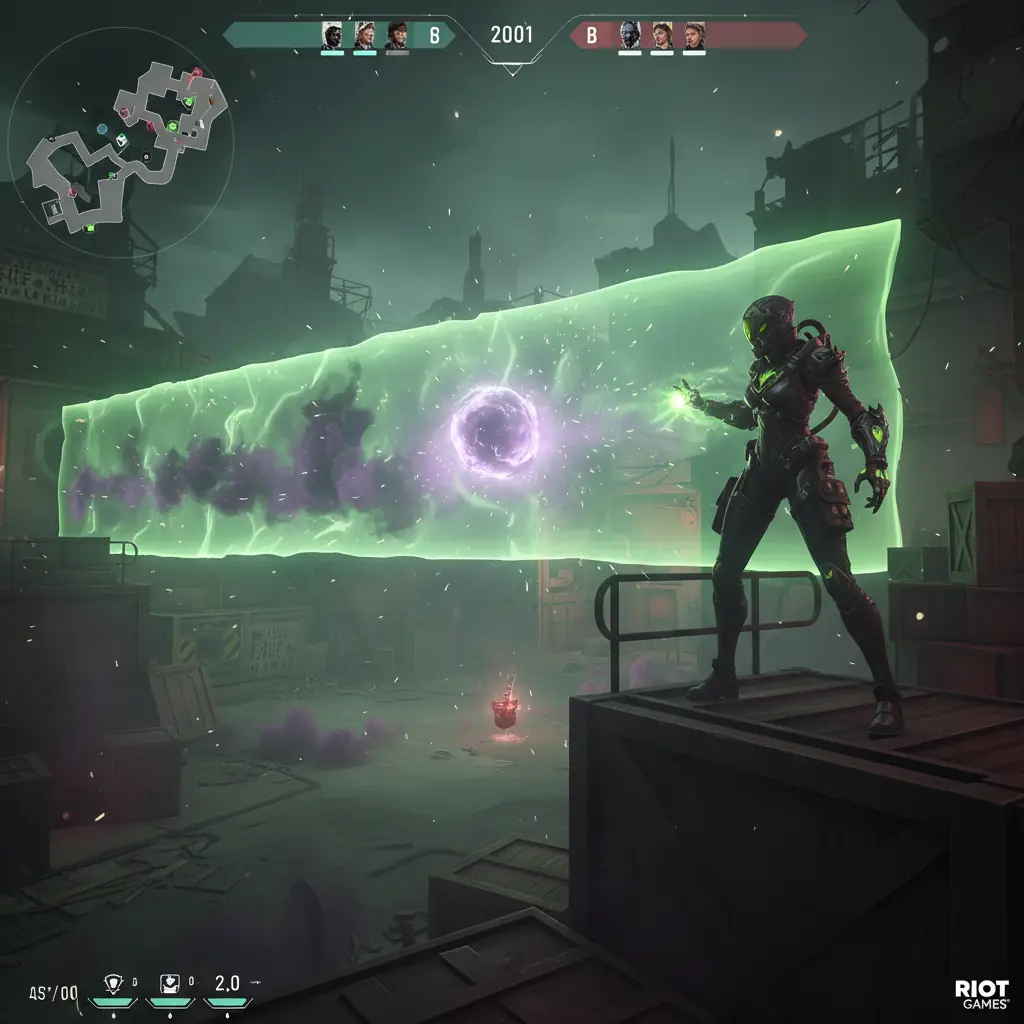
Viper’s Toxic Screen is a terrain-piercing wall of toxic gas, a signature ability that defines her control over the battlefield. On attack, this wall can slice sites in half, creating safe entry points while cutting off enemy sightlines. For defense, position the wall to block off crucial chokepoints, forcing attackers into predictable paths. Mastering the art of baiting with the wall involves dropping it briefly to lure enemies into a false sense of security, only to reactivate it and trap them in a deadly crossfire. The Toxic Screen is more than just a barrier; it’s a tool for manipulating enemy movements and creating advantageous engagements.
Poison Cloud [Q]
The Poison Cloud is a versatile tool for area control and vision denial. This gas emitter creates a toxic cloud that obstructs vision and decays the health of anyone who dares to enter. As Viper, players can deploy and recall Poison Cloud, giving a degree of control unique among controllers. Offensively, use the cloud to smoke off chokepoints, forcing enemies to reposition or risk taking heavy damage. In post-plant situations, combine it with Snake Bite to create a zone of excruciating pain, denying defuses and securing victories. Timing is everything in the world of Viper. Sometimes that means not using an ability. Instead, holding it to bait enemies, or switching up tactics to catch opponents off-guard. Thinking through these options is what separates a good Viper player from a great one.
Snake Bite [C]
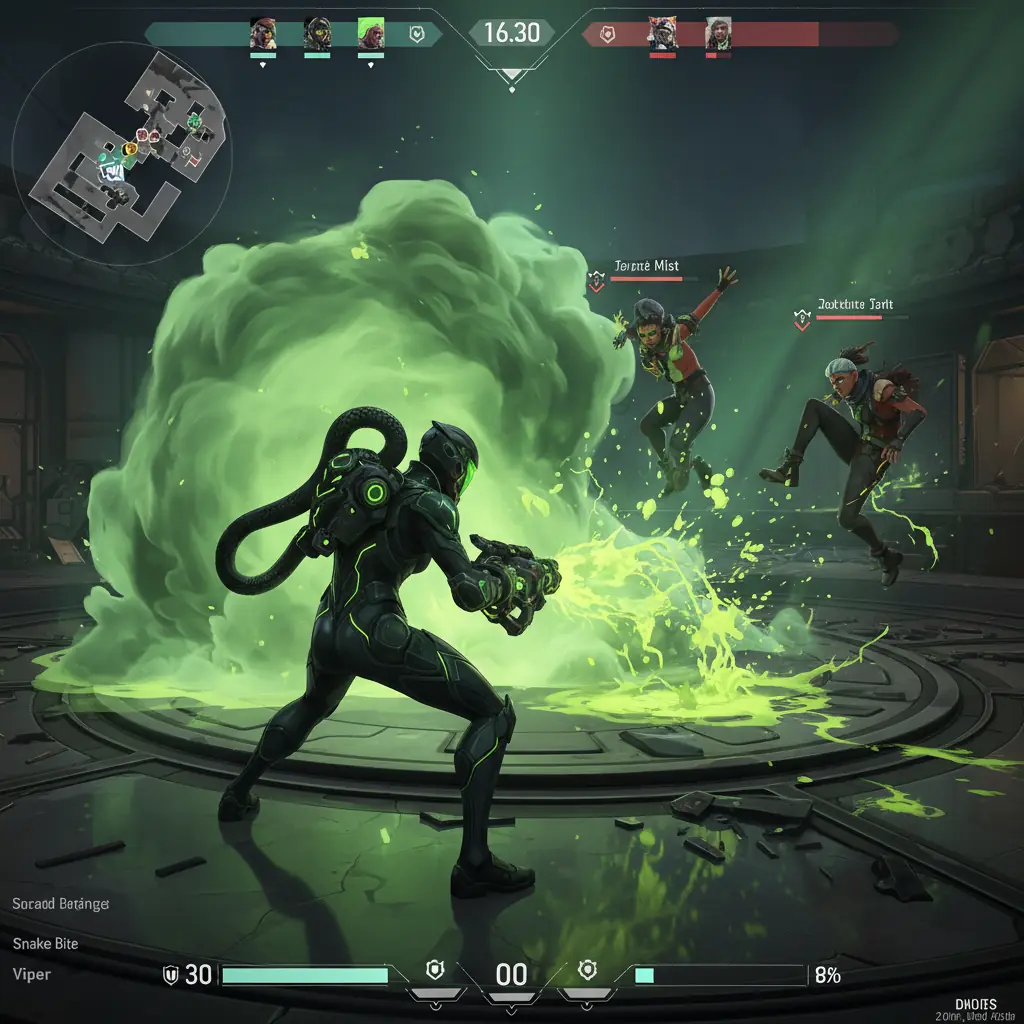
Snake Bite is Viper’s version of a molly, a canister that explodes into a pool of acid, dealing damage over time to anyone caught in its area of effect. Unlike other abilities in the roster, Snake Bite is not as easily seen. Using Snake Bite to clear corners forces enemies to reposition, making them vulnerable to predictable attacks. The ability also denies space, stalling pushes and defuses alike. While there are various specific Snake Bite lineups that allow Viper players to defend a planted Spike from a safe distance, creative use in the moment is paramount to mastering Viper. Smart placement and timing of Snake Bite are essential for controlling the flow of battle and securing crucial kills.
Viper’s Pit [R]
Viper’s Pit, her ultimate ability, is a game-changing toxic cloud that blankets an area, reducing vision range and maximum health of players inside. However, Viper must remain inside of it to keep it active. While inside, Viper has the ultimate upper hand. On attack, use Viper’s Pit to lock down a bombsite, creating a chaotic environment where enemies are at a severe disadvantage. When defending, deploy the pit to deny entry points and force attackers to push through a deadly gauntlet. A key strategy involves varying weapon choices within the pit. Also, confusing enemies by staying in unexpected locations grants a significant edge. If faced against a Viper’s Pit, try entrying all at once and focus fire will give players the best chance of taking Viper down before she can lock down an area.
Breeze Domination with Viper: Lineups and Strategies
Breeze, with its open spaces and long sightlines, offers a unique playground for Viper. With the right lineups and strategies, she can lock down sites, control crucial areas, and leave the enemy team choking on her toxins. Viper’s kit, combining walls, poison clouds, and snake bites, makes her a formidable controller on this map, capable of dictating the pace of engagements and turning the tide of battle. Expect to control the map by cutting sites in half and gaining full control over the enemy team while attacking or defending. Viper’s strengths on Breeze lie in her ability to isolate areas, delay pushes, and post-plant control, making her a valuable asset for any team looking to conquer this tropical paradise.
A Site Takes
Taking A site on Breeze can be a breeze with Viper’s wall. Imagine a scenario: the wall cuts off the site, going from left to right, isolating the back site and forcing defenders into a direct confrontation. With the site cut in half, the entry fragger capitalizes, clearing the remaining angles with ease. Planting becomes a formality. This wall placement allows for aggressive pushes and quick site control.
B Site Takes
B site demands a different approach, where Viper’s poison cloud is more effective. Picture this: a perfectly placed cloud shrouding the default plant spot, giving your entry fragger a safe passage to take control. Once inside, the Defenders are vulnerable and in a disadvantaged position. Coordinate with your team, capitalize on the chaos, and watch B site fall with ease.
Viper in the Pro Scene: Analyzing Esports Play
Viper has become a prominent agent in the Valorant professional scene, with pro players showcasing her versatility and impact in esports matches. Her ability to control areas and disrupt enemy strategies makes her a valuable asset in various team compositions.
Professional players frequently use Viper as both a controller and a sentinel, adapting her role based on the map and team needs. For example, on maps like Breeze and Icebox, Viper functions as a primary controller, effectively cutting off sightlines and dictating the pace of engagements. Pros often pair her with Cypher on Breeze or Killjoy on Icebox to fortify their defenses and control key areas. On Bind, Viper shines as a sentinel, using her Snakebites and Poison Cloud to stall enemy pushes and secure bomb sites.
At the Champions Tour (VCT) level, teams often prioritize Viper on maps like Bind, Breeze, Icebox, and Split due to her strategic advantages. A notable trend among pro Viper players is their focus on maximizing her wall placement for aggressive pushes and defensive setups. Players like to use Viper’s Toxic Screen to isolate opponents or create choke points, giving their team a tactical edge. For instance, during a VCT match, one team used Viper’s wall to divide the enemy team on Ascent’s B site, leading to a successful retake and round win.
Innovative strategies also include using Viper’s ultimate, Viper’s Pit, to control bomb sites or deny entry to key areas. Pro players often combine her ultimate with Snakebites to create a deadly zone, making it difficult for enemies to push or defuse the spike. Specific players have demonstrated exceptional skill with Viper, consistently using her abilities to turn the tide of matches and secure victories for their teams.
Adapting Viper: Team Compositions and Counters
Viper’s effectiveness is greatly influenced by team composition and the strategies of the opposing team. Understanding agent synergies and potential counters is crucial for maximizing Viper’s impact on the battlefield. Knowing when to pick Viper, and when to choose a different controller, can significantly improve the chance of success.
Synergistic Compositions: Viper shines when paired with agents who can capitalize on her area denial and vision control. Agents like Cypher can provide valuable information about enemy movements, complementing Viper’s ability to control sightlines. Sova’s recon abilities combined with Viper’s toxic screen allow for coordinated site takes and retakes. Duelists like Jett or Raze can use Viper’s walls to safely enter sites. Good team compositions will maximize Viper’s ability to control space and secure key rounds.
Viper’s Counters: While Viper is a formidable agent, certain agents can directly counter her strategies. For example, a well-placed Breach can disrupt Viper’s control of an area. Initiators that reveal enemy locations can give the other team the knowledge needed to play around Viper’s setups. When facing these types of counters, it’s important being more dynamic and unpredictable with ability usage.
When NOT to Pick Viper: Consider the map and the team’s overall strategy. On maps with very open areas, Viper’s short walls might not be as effective. If the team already lacks entry frag potential, another controller might be a better choice.
Fueling the Serpent: Managing Resources Effectively
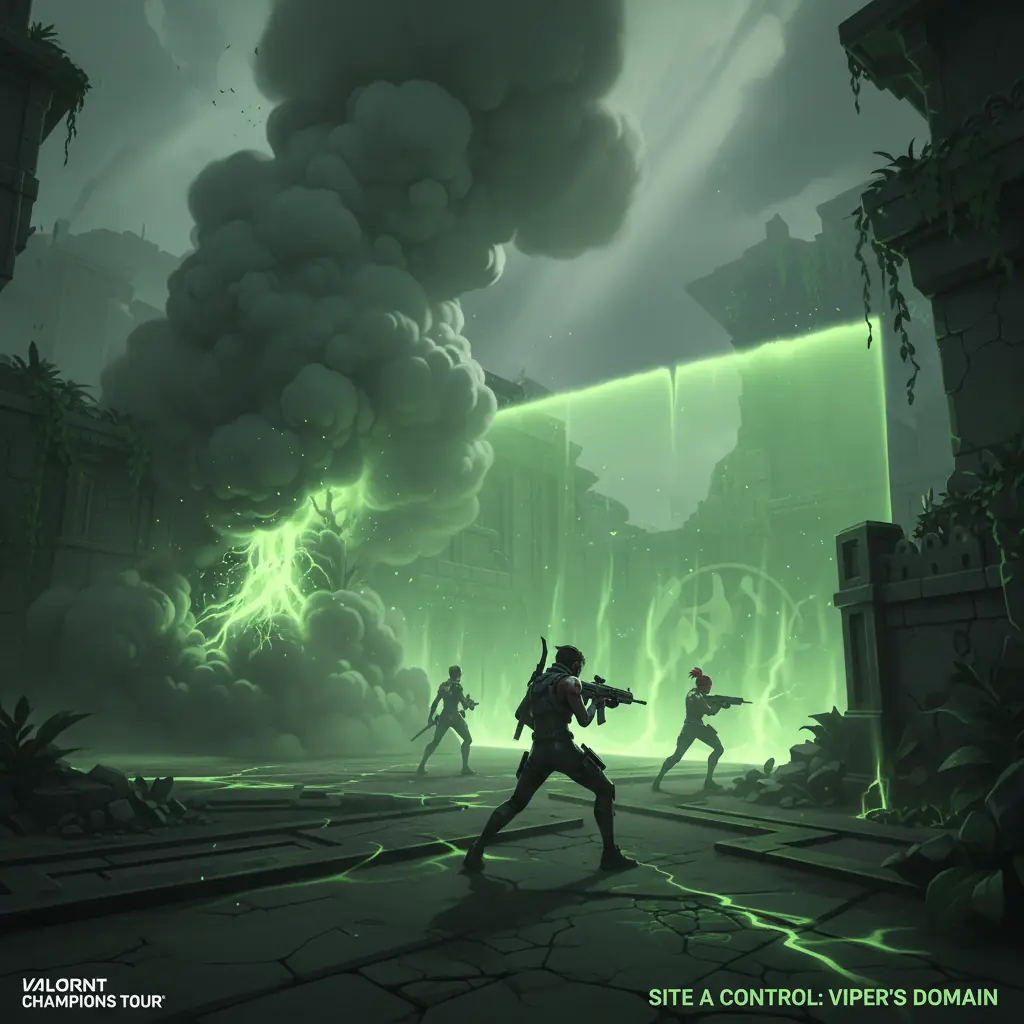
Viper distinguishes herself in Valorant through a unique resource system: fuel. Mastering this mechanic is essential to maximizing her potential. Unlike other agents who rely solely on cooldowns, Viper’s Toxic Screen and Poison Cloud draw from a shared fuel pool, demanding strategic consumption. Conserving fuel isn’t just about preserving resources; it’s about dictating the pace of engagements and maintaining a tactical edge.
Effective fuel management requires understanding the nuances of each ability. The Toxic Screen, capable of bisecting sites and creating choke points, is a voracious fuel consumer when active. Likewise, the Poison Cloud, while reusable and strategically potent, demands patience. Consider toggling abilities to conserve fuel if you notice no enemies are being effected.
Economy management further intertwines with fuel usage. During eco rounds, where credits are scarce, prioritize fuel conservation to retain defensive capabilities. Conversely, on rounds with ample credits, don’t hesitate to aggressively deploy Toxic Screen and Poison Cloud in tandem to overwhelm opponents. Recognizing the ebb and flow of your team’s economy, and adapting Viper’s resource expenditure accordingly, distinguishes a novice Viper player from a master strategist.
Advanced Viper Tactics: Mind Games and Deception
Viper isn’t just about toxic clouds and walls; it’s about playing mind games. To truly master Viper, you’ve got to get into your opponent’s head. This means using deception, baiting, and faking to create opportunities and control the flow of the game.
Baiting is a classic tactic. Use your Toxic Screen to make enemies think you’re pushing a certain direction, then quickly rotate elsewhere. Make them second-guess every move. Throw a Snake Bite to make them think you are defending a certain spot. The sound cues in this game are huge, so use those to your advantage.
Faking is another great option, and Viper is excellent at it. Start to deploy your ult, then cancel it. This can make enemies panic and waste utility. You can fake a plant and make them think you’re in one spot. Once they decide to rush you, the zone is all yours.
The key is to be unpredictable. If you do the same thing every round, skilled opponents will catch on quick. Mix up your tactics, keep them guessing, and make them fear your next move. When you throw them off balance, Viper is a menace.
Conclusion
In summary, Viper emerges as a formidable force within Valorant’s controller class, distinguished by her toxic abilities and strategic map control. Her journey from a conventional vision blocker to a post-plant powerhouse showcases her adaptability and enduring relevance in the ever-evolving meta of Valorant. What sets Viper apart is her capacity to dictate the terms of engagement. Whether it’s through vision denial, area denial, or calculated post-plant maneuvers, Viper’s toolkit equips players to dominate choke points and secure crucial rounds.
The key to mastering Viper lies in understanding her abilities and applying them strategically. Knowing when to deploy her Toxic Screen, when to unleash her Poison Cloud, and how to maximize her ultimate can significantly elevate a team’s performance. Now that one has learned the essential strategies, it’s time to put them into practice. Experiment with different lineups, refine timing, and adapt to various map scenarios to fully unlock Viper’s potential. Remember, the most effective Viper players are those who can think ahead, anticipate enemy movements, and execute their plans with toxic precision. Share this guide with teammates, discuss strategies, and leave a comment!